
Art trail set to supercharge The Waimate Trail
Creatives from across Waimate District are being brought together on an ambitious project to “supercharge” The Waimate Trail – Te Ara Waimatemate.
Large-scale murals, a giant bicycle, a ghost-like moa, 100 butterflies and stone carvings are among the artworks planned for Footsteps of Our Ancestors, the trail's outdoor sculpture project.
Developed by Waimate2gether in collaboration with Te Rūnanga o Waihao, the trail is drawing on skills from across the district, bringing groups, artists and students together, creating opportunities to learn from each other, get involved and leave their own mark on the trail. The aim is to create a world-class outdoor gallery that becomes an attraction in its own right, while telling Waimate's story in the landscape where much of it happened.
The first stage: Wai / Water
Project manager Jo Sutherland says the theme recognises water as “a source of life, connection and identity”.
“Water has carried people here, sustained communities, shaped the landscape and linked generations.”
As the trail follows the journey between the Waimate and Waihao rivers, the artworks will explore the district's history, environment and the different ways people have moved through it.
“Some artworks will speak of arriving by boat, some by rail, some by bicycle and some by wings. Others will celebrate the birds, plants, waterways and cultural traditions that make this district special.”
Large scale history
Among the largest projects planned is a mural by Waimate artist Bill Scott depicting the former Waimate
Branch Railway Station. At 33.6 metres long and 2.4 metres high, it will go on the fence beside the Norman Kirk Memorial Swimming Pool - the site where the railway station once stood.
“It's a striking visual link to a time some people only know through photographs and stories,” says Jo.
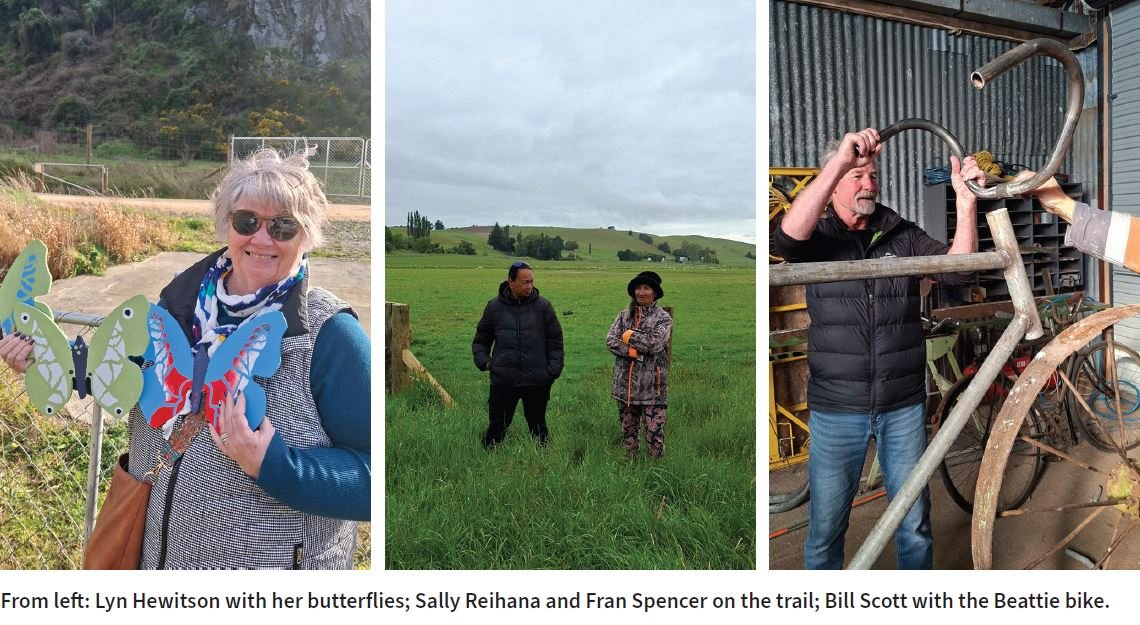
Scott, an engineer as well as an artist, is responsible for some of Waimate's most recognisable public art, including the murals on the towering silos. He has also designed a giant sculpture of James Herries Beattie's bicycle, with Waimate Menzshed and other community members helping to fabricate its parts.
Beattie, a Waimate bookseller and historian, became known as “The Man With the Bike” after cycling around the South Island recording stories from Māori elders and early European settlers. His 1901 Massey-Harris bicycle is now held by the Waimate Museum.
According to Bill, these works, like the silos, draw on Waimate’s history, and he hopes people enjoy them.
“It’s a real buzz just to see people enjoying my art. Public art is free and not hidden away. When I see people looking and taking photos, that’s my joy.”
A ghost from Kapua
Artist Fran Spencer is creating large-scale kererū and moa sculptures.
The kererū will be built around a custom stainless-steel frame, with silver and black mesh used to reflect the distinctive colouring of the bird's breast.
At Kapua, Spencer's moa will use insect-grade aluminium mesh over a stainless-steel structure to create a ghost-like, translucent silhouette - a reference to the area's remarkable moa history and a species now gone from the landscape.
Weaving knowledge into the trail
Other trail projects draw on traditional weaving, natural materials and knowledge of the land.
Sally Reihana will lead workshops creating ruru, kiwi and kōtuku from houhere (lacebark) and wire, teaching participants about the birds, sustainable harvesting and whatu, a traditional hand-binding technique.
Nestled in native bush, the natural sculptures are designed to weather over time and return to the earth.
Reihana will also teach the traditional process of making mōkihi, with harakeke and raupō harvested, dried, twisted into rope and woven into reed rafts for the trail - connecting the artwork back to water and generations of people who have travelled, lived and worked alongside it.
A kaleidoscope of culture
Further along the trail, artist Lyn Hewitson is working on an installation of 100 wooden butterflies on the fence line through the gorge section.
Inspired by the Red Admiral, the installation is a celebration of the different cultures represented here.
School students are creating designs that represent their nationality, heritage or country of origin, with selected designs hand-painted onto the butterflies.
Hewitson recently discovered that a gathering of butterflies is called a kaleidoscope - a fitting description for the collection.
The project has support from the Creative Communities Grant Scheme, Waimate Menzshed, ITM,Dulux and Waimate2gether.
A digging stick tells an ancient story
Artist Chris Harvey is creating Tūwhakarōria, a sculpture based on the traditional kō, or digging stick.
The work will be made from wood and galvanised steel, with carved and painted elements and an etched bronze plate.
The artwork draws on the story of Rākaihautū, who travelled through Te Waipounamu using his kō to dig out lakes and waterways – connecting the trail with one of the earliest stories of people and the landscape.
Thirteen communities in stone
Local artists Michael Bajko and Jane Scott will lead stone-carving workshops with young people to create 13 kilometre markers, each representing one of the district's communities.
Installed at one-kilometre intervals along the trail between Waimate and Waihao Downs, the markers will contribute to the open-air gallery created with input from younger community members.
A new take on whata kai
Jane Scott and Wendy Heath are working with Waituna Creek and Waihao Downs schools to create a contemporary interpretation of a traditional Māori whata kai.
Traditionally used to dry and preserve food, the whata kai will be reimagined as public art.
A tall wooden rack will hold forms made from recycled tractor inner tubes representing strips of tuna (eel) hung to dry, with students designing and painting the hanging elements using Māori-inspired patterns and symbols.
Bringing people together
As Wendy Heath, of Te Rūnanga o Waihao, puts it: “It is like a mat; it takes a lot of different strands woven together to make the finished product.”
The project is bringing together artists and people from across the community, with support and advice from Waimate District Council.
“Art brings people together. It starts conversations, encourages learning and gives people a reason to stop, look and share an experience. That sense of connection and community is what this is all about.”
Waimate2gether thanks District Life for collaborating with us on this article. Read the full article here